

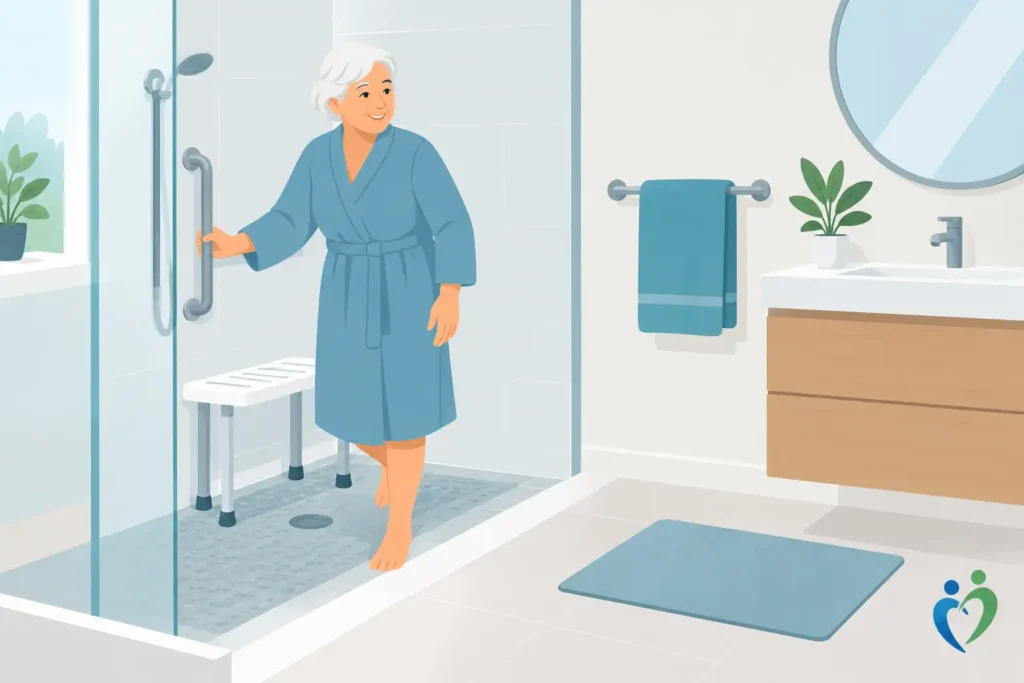
Bathroom Fall Prevention for Safer Bathing
A slip while stepping over the side of a bath can change how someone feels about their whole home. Bathroom fall prevention is not about taking away choice or making a room look clinical. It is about removing the moments that feel unsteady, so bathing can remain private, comfortable and confidently part of everyday life.
For many people, the risk develops gradually. A once-manageable bath side feels higher, standing under the shower becomes tiring, or a wet floor creates worry after a near miss. For family members and carers, concern often begins before the person using the bathroom feels ready to ask for help. A thoughtful adaptation can address both: keeping the individual in control while giving everyone greater peace of mind.
Why bathrooms create a higher falls risk
Bathrooms combine hard surfaces, water, tight turning spaces and tasks that often involve bending, reaching or transferring from one position to another. This can be difficult for older adults, wheelchair users and people living with arthritis, balance problems, reduced strength, neurological conditions or recovering from illness.
The bath is often the biggest challenge. Lifting a leg over a high edge requires balance and hip movement at precisely the point where there may be little to hold. Getting back out can be harder still, particularly when muscles are tired after bathing. A standard shower over the bath may appear flexible, but it still asks the user to step in and out of a confined, slippery space.
It is not always the bath itself. Poor lighting, loose mats, low toilets, awkwardly positioned taps and doors that restrict access can all contribute. The right answer depends on the person, their existing bathroom, and whether their needs are likely to change over time.
Bathroom fall prevention starts with the daily routine
Before choosing equipment, consider what actually happens in the room. Is the main difficulty getting into the bath, standing for a shower, washing hair, reaching toiletries, or moving from a wheelchair or walking frame? Does someone need help now, or do they want a room that allows them to manage independently for longer?
A good bathroom design looks at the full routine rather than one isolated problem. For example, a grab rail by the toilet may assist one transfer, but it will not solve an unsafe bath entry. Equally, replacing a bath with a shower may not suit someone who finds a warm soak eases pain or simply values that part of their routine.
A home assessment is valuable because measurements alone do not tell the whole story. The layout, floor level, turning room, door position and the way a person moves all affect what will feel safe in practice. It also provides an opportunity to discuss household preferences, décor and budget without pressure.
Choose the right bathing solution
There is no single best option for every household. The safest choice is one that supports the user’s current ability, gives room for future needs where possible, and fits naturally into the home.
Walk-in baths for seated, supported bathing
A walk-in bath has a low-entry door, removing the need to climb over a high bath side. Once inside, the user can sit comfortably and bathe with the reassurance of secure access. Some models are designed for a full-length bathing experience, while shorter options can suit smaller rooms.
A walk-in bath can be an excellent choice for someone who enjoys bathing but struggles with the step over a conventional bath. The trade-off is that the person usually enters before the bath fills and waits inside while it drains. Fast-fill and fast-drain features can reduce that wait, but it is still worth discussing whether this routine will be comfortable.
Walk-in shower baths for flexibility
Where more than one person uses the room, a walk-in shower bath can offer a useful middle ground. It combines easier access with the option of showering or bathing, making it practical for households with differing needs.
This approach can work well when a person wants to keep a bath but has begun to find the standard side difficult. As with any adaptation, the door opening, internal seat, controls and available space should be assessed carefully. A feature is only helpful if it is easy for the intended user to operate safely.
Level-access showers and wet rooms for step-free entry
A level-access shower or wet room removes the raised tray and creates a more open route into the showering area. For a person using a wheelchair, walking frame or shower chair, this can make a substantial difference to daily independence.
A well-designed wet room does not have to feel institutional. Careful choice of tiles, screens, storage, lighting and fittings can produce a calm, attractive bathroom while allowing for drainage and safer movement. Space is a consideration: the room needs enough area for comfortable transfers and, where needed, carer assistance.
For people who become tired while showering, a fixed or fold-down shower seat can provide security without making the room feel cramped. Thermostatic controls are also worth considering, as they help prevent sudden changes in water temperature.
Bath lifts and practical support
A bath lift may suit someone who can still use their existing bath but finds lowering down and standing back up difficult. It can be a less disruptive option than a full refurbishment, particularly where the current bathroom is otherwise suitable.
However, a lift does not remove the need to get over the bath side. If stepping in is already unsafe, or if balance is deteriorating, a low-entry bath or shower solution may offer better long-term reassurance. This is why genuine recommendations should consider the whole transfer, not simply the point at which a person sits down.
Small changes that support safer movement
Larger adaptations often make the greatest difference, but details matter too. Bright, even lighting helps people judge distances and see wet areas clearly. Lever-style taps can be easier to use than small twist controls, particularly for sore or weak hands. Easy-to-reach shelving keeps shampoo and towels close by, avoiding unnecessary stretching or turning on a wet floor.
Grab rails should be positioned for the person and the task, not added as an afterthought. A rail needs to be securely fixed and placed where it supports a natural movement, such as standing from the toilet or stepping into the shower. Towel rails and lightweight fittings are not designed to take body weight.
Non-slip flooring can provide useful grip, but it should not be treated as a substitute for safe access and good layout. Avoid loose bath mats where possible, especially if they curl at the corners or slide beneath the feet. If a mat is needed, choose one that lies flat and is checked regularly.
Make room for dignity as well as safety
The emotional side of bathroom changes deserves as much attention as the practical side. Many people worry that accepting help or changing their bathroom means losing independence. In reality, the right adaptation can protect it: less fear around bathing, fewer calls for assistance and greater confidence in a familiar home.
Appearance matters too. An accessible bathroom can reflect the rest of the house, whether that means warm colours, contemporary fittings or a traditional look. Safety features do not need to announce themselves. The best designs feel considered and personal, not temporary or medical.
If a relative is involved in the decision, keep the person using the bathroom at the centre of it. Ask what they miss doing comfortably, what they find worrying, and what would make the room feel like theirs. A solution chosen with them is far more likely to be used with confidence.
When to arrange a professional assessment
It is sensible to seek advice after a fall, but waiting for one is not necessary. Repeated near misses, difficulty lifting a leg over the bath, needing to hold onto unsuitable fittings, or avoiding bathing because it feels exhausting are all signs that the room is no longer working well.
For households in South Wales, a specialist home visit can turn those concerns into a clear plan. Affect Ability considers the person, property and preferred style before managing the design and installation, helping to minimise disruption while creating a bathroom that is safer to use every day.
A safer bathroom is not about doing less. It is about making space for the ordinary comforts that matter: a relaxed shower, a favourite bath, and the confidence to close the door and manage on your own terms.