

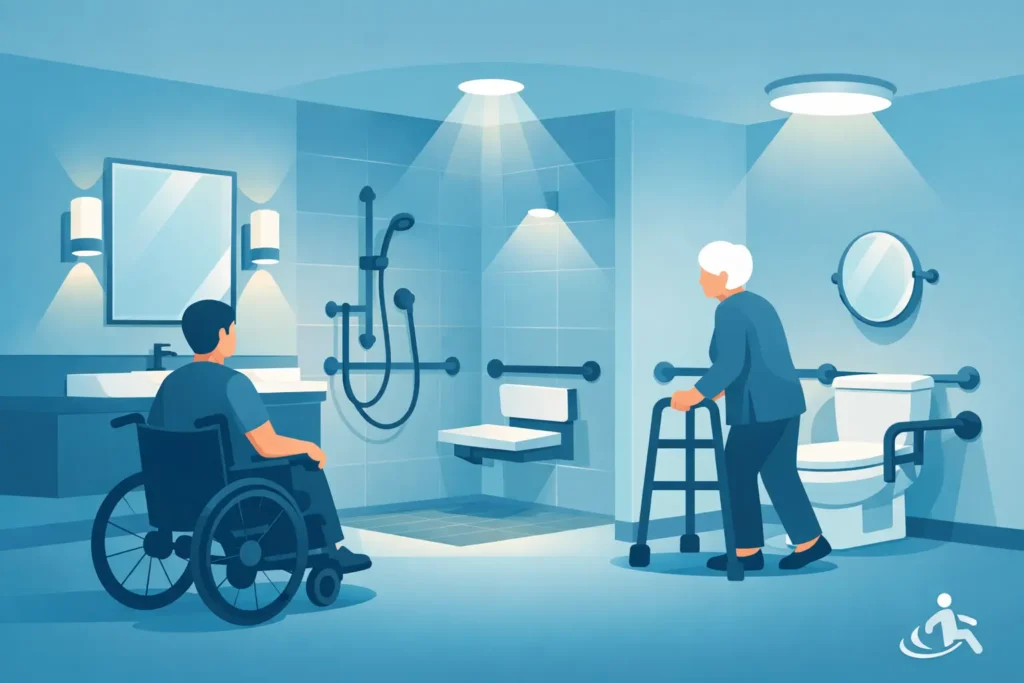
Bathroom Lighting Safety for Accessible Homes
A bathroom can look perfectly serviceable in daylight yet become difficult to use when the light is poor, a fitting throws glare across wet tiles, or a switch cannot be reached safely. For someone managing reduced mobility, poor balance or changing eyesight, bathroom lighting safety is not a finishing touch. It is part of creating a bathroom that feels comfortable, dignified and dependable every day.
Good lighting helps people judge distances, find grab rails, see the shower controls and transfer safely in and out of a bath. It also gives family members and carers confidence that the room is working for the person who uses it, rather than asking them to take unnecessary risks.
Why bathroom lighting safety deserves proper planning
Bathrooms bring together water, steam, smooth surfaces and electrical fittings. That combination means lighting must be selected and installed with more care than it would be in a bedroom or hallway. A standard decorative light fitting may not be suitable near a shower, bath or basin, even if it looks right for the room.
There is also the practical question of visibility. Shadows around the bath edge, a bright bare bulb reflected in a mirror, or a dim corner by the toilet can all make a familiar bathroom harder to navigate. This matters particularly for people living with arthritis, Parkinson’s, sight loss, dizziness, dementia or reduced confidence following a fall.
The aim is not to make a bathroom feel clinical. It is to create clear, even, comfortable light that supports independent bathing while complementing the rest of the home.
Start with the route through the room
A safer lighting plan begins before choosing a fitting. Consider what someone needs to see from the moment they approach the bathroom, especially at night. The route from the bedroom to the door, the door handle, the toilet, basin and bathing area should all be easy to identify without sudden changes between darkness and harsh brightness.
For an accessible bathroom, this often means using more than one light source. A central ceiling fitting can provide general illumination, while carefully placed task lighting can make the mirror, shower controls and bathing area clearer. The right arrangement depends on the size and layout of the room. A compact shower room may need only well-positioned ceiling lights, whereas a larger wet room may benefit from separate lighting zones.
Avoid relying on a single bright fitting in the middle of the ceiling. It can leave shadows where they matter most, particularly if a person is standing close to a basin or using a shower seat. Even lighting is usually more useful than dramatic lighting in a room designed for safe daily use.
Make switches easy to reach
A light is only helpful if it can be operated without stretching, twisting or entering a dark room. Where possible, the main switch should be positioned where it is easy to reach on entry. This is particularly valuable for wheelchair users and anyone who uses a walking frame or needs a carer’s support.
Pull-cord switches remain a familiar bathroom option, but the cord length and position need consideration. It should be reachable without leaning over a bath or stepping into a shower area. In some homes, appropriately specified external switches or sensor controls may be a better choice. A professional will advise on what is suitable for the layout and electrical safety requirements.
Motion-sensor lighting can be helpful for night-time trips to the bathroom, especially when paired with a gentle low-level light. However, it needs to be set up thoughtfully. A sensor that switches off while someone is sitting still, showering or dressing can be unsettling and unsafe. Choose controls with a suitable detection range and time delay rather than assuming every automatic option will work for every household.
Choose fittings rated for bathroom use
Bathroom lighting is divided into electrical safety zones based on how close a fitting is to water. The closer the fitting is to a bath, shower or wet area, the greater the protection it needs against water ingress. This protection is shown by an IP rating.
The exact IP rating required depends on the zone and the nature of the installation. For example, a light directly above a shower needs a higher level of water protection than a fitting further away on the ceiling. Wet rooms require particularly careful planning because the whole space may be exposed to moisture and splashing.
It is tempting to choose lighting purely by appearance, then try to make it fit the room. A safer approach is to establish which fittings are appropriate first, then select a style that suits the décor. There are plenty of modern, discreet bathroom-rated options, from recessed downlights to flush ceiling fittings, so accessibility does not have to mean compromising on a welcoming finish.
Electrical work in a bathroom should be carried out by a suitably qualified electrician who understands current UK requirements. They can assess the zones, select appropriate fittings, check earthing and protection, and make sure the work is tested and certified where required. This is not a job for improvised alterations or an unqualified installer.
Reduce glare and improve contrast
Brightness alone does not guarantee good visibility. In fact, glare can make a bathroom harder to use, particularly for older eyes or people with cataracts, macular degeneration or sensitivity to light. Highly polished tiles, chrome taps and mirrors can reflect a strong exposed light source straight into the user’s eyes.
Diffused lighting, where the bulb is screened by a suitable cover, is often more comfortable than a visible bare lamp. Around the mirror, lighting positioned to each side can reduce shadows on the face more effectively than one bright light directly overhead. This can make shaving, applying skincare or checking for irritation easier and more comfortable.
Contrast also plays a useful role. Light levels should make it easier to distinguish the edge of a shower tray, the outline of a grab rail, the toilet seat and the controls on a walk-in bath. Lighting cannot solve every contrast issue on its own, but it supports a thoughtful choice of wall finishes, flooring and bathroom fittings.
Think carefully about mirror lighting
An illuminated mirror can be a practical addition, but it must be rated for bathroom use and installed in the correct location. Look for an evenly lit mirror rather than one that creates a bright halo with darker areas around the basin. If a household member sits to wash or groom, check the height and angle from their usual position.
Features such as an integrated shaver socket, demister pad or touch control can be convenient, but convenience should never outweigh simplicity. For some users, a clearly marked conventional control is easier to understand and operate than a small touch-sensitive area. The best choice is the one that works confidently for the person using the room.
Plan for night-time bathroom visits
Night-time is when many bathroom falls happen. Someone may wake suddenly, feel unsteady, or avoid switching on a main light because it is too bright. A soft guide light along the route to the bathroom, near the skirting, or beneath a vanity unit can make movement safer without fully waking the household.
Low-level lights should illuminate the floor clearly enough to reveal changes in level, mats and door thresholds. They should not create pools of light and dark that make depth harder to judge. In a wet room or level-access shower, clear floor visibility is especially valuable because there may be no tray edge to define the bathing area.
Portable plug-in night lights may seem like a quick answer, but bathrooms and nearby circulation areas can have limited socket locations. A properly planned fixed solution is usually neater, more reliable and less likely to introduce trailing leads or unsuitable equipment near moisture.
Match lighting to the bathroom adaptation
The right lighting should support the way the bathroom is actually used. A walk-in bath needs clear illumination around its door, seat and controls. A level-access shower benefits from light that reaches the showering position without casting a person’s own shadow over the controls. In a bathroom with a bath lift, lighting should make transfer points and handholds easy to see.
For people who need assistance, the room should also provide enough light for a carer to work safely and respectfully. This may mean adding task lighting around the bathing area, not simply increasing the wattage of the main ceiling light. The finish can still be attractive and calm, with fittings chosen to suit existing colours and fixtures.
At Affect Ability, a bathroom assessment considers how the person moves through the room, where support is needed and how the finished space should feel. Lighting is one part of that wider picture, alongside safe access, flooring, showering or bathing equipment, ventilation and a layout that makes everyday routines easier.
Keep the installation safe over time
Once new lighting is installed, basic care helps it continue to perform as intended. Replace failed lamps with the correct type and rating, keep diffuser covers clean so light levels do not gradually drop, and have damaged fittings checked promptly. Condensation, flickering lights, repeated tripping or a warm switch should never be ignored.
Good extraction is relevant too. An effective bathroom fan helps reduce lingering steam, which protects finishes and electrical fittings as well as making mirrors clearer. If the bathroom is being refurbished, it is sensible to plan the fan and lighting together rather than treating ventilation as an afterthought.
A well-lit bathroom will not remove every risk, but it can make daily bathing feel markedly calmer and more manageable. When lighting is planned around the person, professionally installed and chosen to suit a beautiful accessible bathroom, it quietly supports something that matters deeply: the freedom to use your own home with greater confidence.