

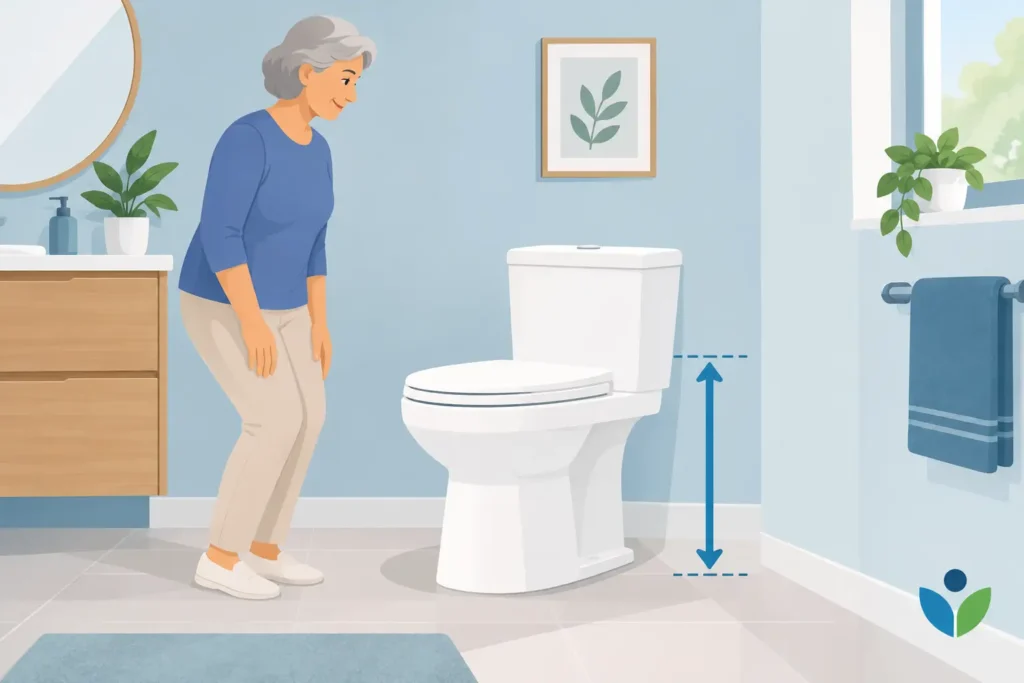
Toilet Height Guide for Safer, Easier Living
A toilet that is just a little too low can turn an ordinary daily routine into a painful, unsteady transfer. This toilet height guide explains how to choose a WC height that supports comfort, safety and independence, without making your bathroom feel clinical.
The right answer is rarely simply “the tallest toilet available”. A suitable height depends on the person using it, their mobility, leg strength, balance, wheelchair height and the layout of the room. It should also work for anyone else in the household wherever possible.
Toilet height guide: the measurements that matter
Toilet heights are generally measured from the finished floor to the top of the pan rim, or to the top of the seat when a seat is fitted. Always check which measurement a manufacturer is giving you. A difference of a few centimetres can make a real difference when sitting down or standing up.
A standard UK toilet pan is often around 400mm to 430mm high to the rim. With a conventional seat fitted, the sitting height is higher. This suits many people, particularly those who are shorter or need both feet firmly supported on the floor.
A comfort-height toilet is usually taller, commonly bringing the finished seat height into the region of 450mm to 480mm. This can reduce the bend at the knees and hips, making it easier for many older adults and people with arthritis, restricted hip movement or reduced leg strength to stand afterwards.
For a wheelchair user, an accessible WC is often planned with the top of the seat between 450mm and 500mm above the finished floor. The aim is to create a manageable transfer height, but there is no single measurement that suits every wheelchair user. The seat height, transfer method, arm strength and preferred side of transfer all need consideration.
Why taller is not always better
A higher toilet can be helpful when lowering down is difficult. However, if it is too high, a person’s feet may dangle or only touch with their toes. That can affect balance, increase pressure behind the thighs and make it harder to move forward to stand.
For someone of smaller stature, or a person who transfers using their feet for stability, a standard-height pan may be safer. A small, stable footstool can sometimes provide support, but it must not create a trip hazard or obstruct a carer’s position. The best choice comes from seeing how the individual sits, rises and transfers in their own home.
Start with the person, not the product
Before choosing a new toilet, think through the movements that happen either side of using it. Can the person approach the WC with a walking frame? Do they use one or two hands to lower themselves? Is twisting painful? Does a carer need space to assist safely?
If a wheelchair is involved, measure the height of the wheelchair cushion as well as the frame. A level or near-level transfer may be preferable for some people, while others are more comfortable transferring slightly downhill or uphill. The direction of transfer matters too. A room designed for a left-side transfer can be awkward and unsafe for someone who transfers from the right.
It is also worth considering changes that may occur over time. Someone recovering from surgery may need a temporary solution, such as a securely fitted raised toilet seat. For long-term mobility needs, replacing the pan and planning the surrounding space usually creates a more stable, attractive and easier-to-clean result.
Raised toilet seat or comfort-height toilet?
A raised toilet seat can be a useful short-term answer where standing has suddenly become difficult. It can be fitted quickly, costs less than a bathroom refurbishment and may provide valuable support while a person recovers or waits for a larger adaptation.
That said, it is not automatically the best permanent option. Raised seats add height on top of the existing pan, can feel less secure if poorly fitted, and may not suit every toilet shape. Some models have arms, which can help with pushing up, but they also need enough room at each side. Cleaning around a detachable seat can be more difficult too.
A comfort-height toilet is generally neater and more secure for a long-term need. It can be selected in a style that suits the rest of the bathroom, including close-coupled, wall-hung and back-to-wall designs. The trade-off is that changing the toilet may involve pipework, flooring and layout considerations, especially in an older bathroom.
The toilet is only one part of a safe transfer
Correct height helps, but it cannot compensate for a cramped or poorly planned room. A person needs enough clear space to turn, position a frame or wheelchair, and use support rails without reaching or twisting too far.
Grab rails should be chosen and positioned for the person’s actual movement, not fitted as a general precaution. A horizontal rail beside the toilet can provide a steady handhold, while a folding support rail may offer useful support where the toilet is away from a wall. Rails must be fixed to suitable structural support, rather than simply attached to an unsupported surface.
The flush is another small detail with a big impact. A large, easy-to-press dual flush plate may be easier for someone with limited grip or dexterity than a small push button. In some rooms, a sensor-operated or remote flush may be worth discussing. Toilet roll holders, bins and radiators should not block the natural route in and out.
For wheelchair users, the outward-opening direction of the door, clear turning space and position of the basin can be as significant as the WC height itself. In a compact bathroom, moving a wall, changing the door arrangement or creating a wet room can provide much more usable space than changing one fixture alone.
How to test whether the height is right
If possible, try a toilet at a similar height before committing to a purchase. Wear the footwear normally used at home and use any usual walking aid. The person should be able to sit down in a controlled way, with their feet supported, then stand without excessive pulling, rocking or pain.
Look for signs that the height is unsuitable: knees rising well above the hips, feet failing to reach the floor, a sudden drop onto the seat, or a need to grip unstable items such as the basin or towel rail. None of these should be treated as an unavoidable part of getting older.
A home assessment is especially valuable when needs are complex or more than one person uses the bathroom. It allows the whole routine to be considered, from entering the room to washing hands afterwards, rather than selecting a toilet from a showroom measurement alone.
Choosing a style that still feels like home
Accessible does not have to mean institutional. Comfort-height WCs are available in contemporary designs, and carefully positioned rails can complement rather than dominate a room. Coordinating finishes, choosing a quality seat and planning storage can make a practical adaptation feel like a considered bathroom refurbishment.
For a full bathroom change, it may make sense to combine the toilet work with a level-access shower, walk-in bath or wet room. This can reduce disruption compared with carrying out separate projects later, while creating a layout that supports safer bathing and toileting together.
Affect Ability plans bathroom adaptations around the person and their home, with genuine recommendations based on how the space is used. For households in South Wales, a no-obligation home visit can take the uncertainty out of toilet height, transfers and the wider layout.
The most reassuring choice is one that lets the person use their bathroom with less effort, more stability and the confidence that their home is still working for them.