

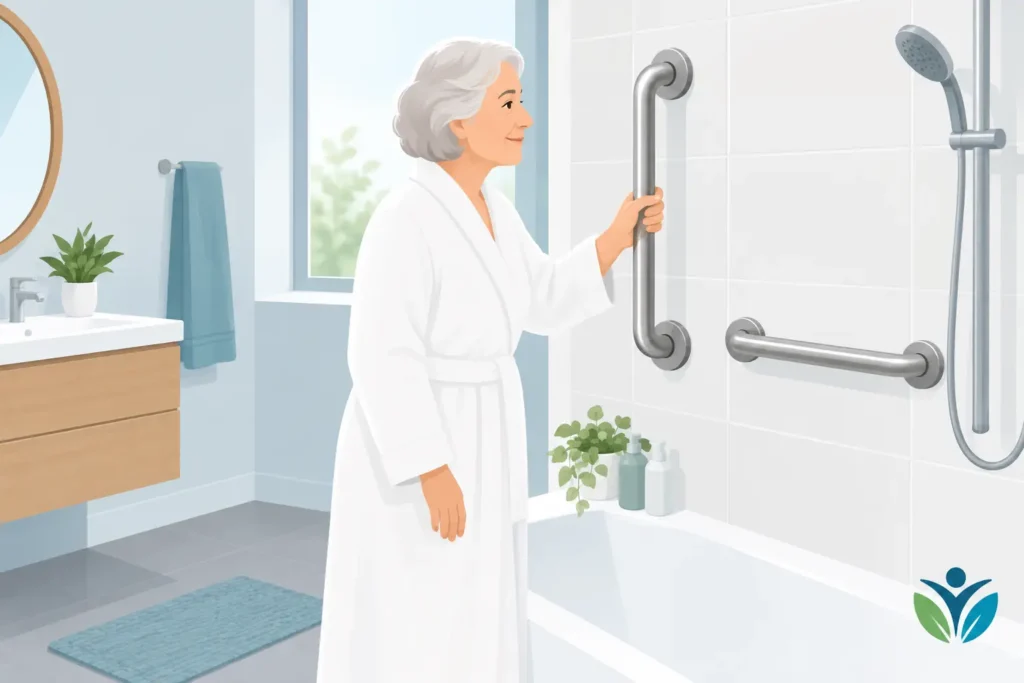
Bathroom Grab Rails for Safer Bathing at Home
A small movement can become the hardest part of a bathroom routine: lowering yourself onto the toilet, stepping over a bath edge, or turning on a wet floor. Well-chosen bathroom grab rails provide a secure, familiar point of support exactly where it is needed. For many people, that support means continuing to bathe independently in the home they know and love.
They are not simply a practical add-on. Positioned properly and fitted securely, grab rails can reduce the worry that often comes before a shower or bath. They can also give family members and carers greater peace of mind, without making the room feel clinical or impersonal.
What bathroom grab rails can help with
A grab rail gives you something solid to hold while transferring, changing position or steadying yourself. The most useful rails support the movements that feel difficult in your own bathroom, rather than following a one-size-fits-all layout.
For example, someone who struggles to rise from the toilet may benefit from rails beside the WC. A person stepping into a walk-in shower may need support just inside the entrance and near the shower controls. Around a bath, a rail can help with balance while entering or leaving, although it should never be relied upon as the only solution where getting over the bath side has become unsafe.
The difference can be significant. Instead of bracing against a towel rail, basin or shower screen – none of which is designed to carry body weight – you have a purpose-made support fitted for the job.
Choosing the right type of grab rail
Grab rails come in a wide range of shapes, finishes and sizes. The best choice depends on the user, the room layout and the transfer or movement being supported.
A straight horizontal rail is often useful beside a toilet, along a wall near a shower entrance, or at the side of a bath. It gives a firm handhold when sitting, standing or moving sideways. Vertical rails can offer useful support when stepping up or down, while angled rails can follow the natural movement of the arm when rising.
Fold-down rails are particularly helpful where there is no suitable side wall next to the toilet. They fold up neatly when not in use, which can make a shared bathroom easier to use. Some models include a leg for extra support, and certain designs can include a toilet roll holder.
For people who have limited grip strength, a rail with a comfortable diameter and a non-slip surface may feel more secure. Contrasting colours can also make a real difference for users with reduced vision. A rail that is easy to see is easier to use with confidence.
Materials and finishes matter too
White plastic-coated rails remain a popular option, especially in traditional bathrooms. However, chrome, stainless steel, brushed nickel, matt black and coloured finishes can all work beautifully in an accessible bathroom. The aim is not to make a bathroom look medical. It is to create a room that feels like part of your home while giving you dependable support.
A smooth finish is generally easy to clean, but the rail must still be comfortable to hold when hands are wet. In a wet room or showering area, quality materials that are suited to damp conditions are particularly important.
Where should grab rails be fitted?
Placement is more important than buying the most expensive rail. A rail fitted a few inches too high, too low or too far away can be awkward to reach and may not support the movement it was intended for.
The right position depends on the person using it. Their height, balance, reach, preferred hand, strength and whether they use a walking frame, wheelchair or other mobility aid all matter. It is also worth considering whether a partner, carer or visiting family member needs room to assist safely.
Common areas include beside the toilet, next to the basin, at the shower entrance, inside a shower enclosure and alongside the bath. Yet these are only starting points. For instance, a rail by the basin can be useful for steadying yourself while washing your hands, but it should not obstruct wheelchair access or make it harder to approach the basin.
A shower is often the priority area
Bathrooms become most hazardous when water, soap and smooth flooring meet an unsteady step. In a walk-in shower or wet room, rails are usually most useful at the point of entry, beside a shower seat and near the controls. This lets the user steady themselves before, during and after washing, rather than reaching across the shower for support.
If showering standing up has become tiring or uncertain, grab rails can work well alongside a fold-down shower seat, a level-access shower tray and a thermostatic shower. These changes are often more effective together than as isolated pieces of equipment.
Why professional fitting is essential
A grab rail is only as safe as the wall and fixings behind it. This is why fitting should never be treated as a simple decorating job, particularly in an older property or a bathroom with tiled walls.
Some walls are solid masonry; others are stud partitions. Pipes, cables, insulation and concealed cisterns may be present behind the surface. A rail needs to be fixed into a suitable structural support using the correct fittings for that wall type. Fixing only into tiles, plasterboard or an unsuitable surface can lead to failure when the rail takes weight.
Professional installers can assess the wall construction, position the rail around pipework and ensure it is level, secure and comfortable to reach. They can also advise when additional reinforcement is required. This is particularly valuable if the bathroom is being refurbished, as concealed strengthening can be planned before walls are finished.
It is equally important not to confuse a towel rail, shower screen handle or heated towel warmer with a grab rail. These items may look convenient, but they are not normally designed to support a person’s weight.
When grab rails are enough – and when they are not
For a person who is generally steady but needs a little extra reassurance, one or two thoughtfully placed rails may be all that is required. They can make an existing bathroom much easier to use without major alteration.
However, rails cannot remove every risk. If stepping into the bath involves lifting the legs over a high side, or if a person cannot stand safely while washing, a wider adaptation may be needed. A walk-in bath, bath lift, walk-in shower or wet room could offer a safer and more dignified long-term answer.
There is no failure in reaching that point. Mobility needs can change gradually after illness, injury or simply with age. Making the bathroom work around the person is often far kinder and more practical than asking the person to keep managing an unsuitable room.
A bathroom that supports independence
The most successful accessible bathrooms are planned around everyday life. They account for how you enter the room, turn, reach towels, use the toilet and wash in comfort. Grab rails are one part of that picture, alongside slip-resistant flooring, suitable lighting, accessible storage and enough clear space to move safely.
A home assessment can be especially helpful where needs are changing or the layout is tight. At Affect Ability, recommendations are based on the person, the property and the way the bathroom is genuinely used, with care taken to create an attractive finished space rather than a collection of equipment.
If you are considering rails for yourself or someone close to you, start with the movement that feels least secure. The right support in the right place can make that daily moment feel calmer, safer and far more manageable.